







Table of Contents
What is SSL?
SSL or Secure Sockets Layer One Encryption protocol which is used to create a secure connection (Encrypted Connection) between Client—Usually the browser—and Server Designed. The main purpose of SSL is to ensure that data exchanged between the user and the server on the Internet cannot be read or manipulated by third parties.
But to better understand SSL, we need to understand its structure and how it works in more detail.
1. At what layer of the network does SSL work?
SSL in Session layer It works between the Application and Transport layers in the OSI model.
That is, SSL directly secures protocols like HTTP and creates a secure version of them, such as:
HTTP → HTTPS
SMTP → SMTPS
FTP → FTPS
This means that SSL is at the heart of network communication and can be used with various protocols.
2. How does SSL secure data? (Expert explanation)
SSL uses three important pillars of security:
1. Authentication
Using SSL Certificate which includes the public key, the browser can verify that it is communicating with Real server It is, not a fake server.
2. Encryption
All data is encrypted between the browser and the server to:
No one can read their content (Confidentiality)
Content does not change along the way (Integrity)
3. Key Exchange
SSL uses asymmetric cryptographic algorithms for key exchange, for example:
RSA
Diffie–Hellman
Elliptic Curve Cryptography (ECC)
After secure key exchange, the connection switches to high-speed symmetric encryption (e.g. AES-128 or AES-256).

3. What is SSL Handshake? (in technical and simple terms)
SSL Handshake is a process in which:
The browser tells the server what version of SSL and what cipher suites it supports.
The server sends the SSL certificate.
The browser validates the certificate (CA / date / domain).
The browser generates and encrypts a session key.
Both parties use this key for fast and secure encryption.
This process is the basis of HTTPS security and all secure web communications.
4. Why is SSL no longer recommended?
SSL has several major problems:
Old and vulnerable encryption algorithms
RC4, 3DES, MD5, and SHA-1 are no longer secure.
Valid attacks against SSL
SSL protects against documented attacks such as:
POODLE
BEAST
DROWN
Heartbleed (for OpenSSL)
It is vulnerable.
SSL versions are completely obsolete.
SSL 1.0—Never released
SSL 2.0—Insecure and Outdated
SSL 3.0—Disabled by all browsers
For this reason TLS has replaced SSL..
5. So why do we still say “SSL Certificate”?
Although the SSL protocol is obsolete, the term SSL Certificate It is still used because:
Established brand
Users are used to it.
Certificates are installed for TLS but remain named SSL.
This means that when you buy an SSL certificate, you are actually buying it for TLS 1.2 or TLS 1.3 It is used.
Why did TLS come about? And what is TLS?
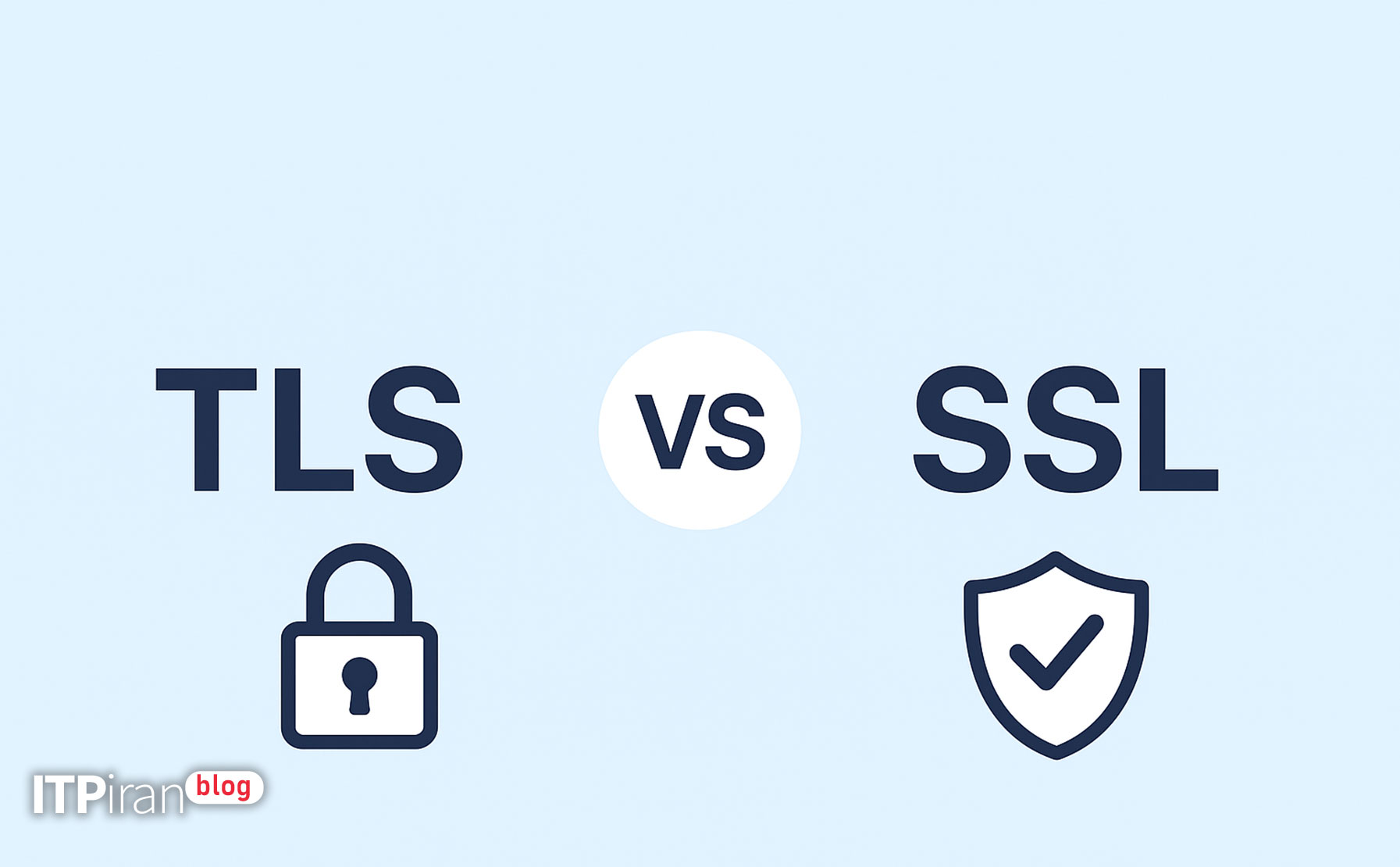
Protocol TLS (Transport Layer Security) It is a new and evolved generation of SSL that was designed to address the security weaknesses of older versions of SSL and provide a more modern standard for secure communications.
During the widespread use of SSL 2.0 and SSL 3.0Serious security issues were identified, including:
Vulnerability to cryptographic attacks (such as POODLE in SSL 3.0)
Weakness in old encryption algorithms like RC4
Lack of proper support for secure key exchange
Vulnerable cryptographic structures and lack of forward secrecy
Because of these problems, the IETF team decided to instead of continuously improving SSL, A whole new generation of security protocol The result was the release of TLS 1.0 in 1999.
What is TLS?
TLS It is a standard cryptographic protocol for creating secure network communications between the data link layer. Transport and the layer Application It is placed.
This protocol guarantees the following when connecting between the client and the server:
1. Confidentiality – Data confidentiality
All data is encrypted before transmission so that it cannot be read if sniffed.
TLS supports modern encryption algorithms such as AES.
2. Integrity – Data integrity
With the help of HMAC, TLS ensures that no attacker can alter data in transit without the client noticing.
3. Authentication
TLS uses digital certificates (X.509 certificates) to authenticate the server and, if necessary, the client.
What distinguishes TLS from SSL?
1. Use more secure encryption algorithms
TLS replaces the weak algorithms of SSL and replaces them with a set of modern and reliable cipher suites.
2. Forward Secrecy Support
TLS 1.2 and TLS 1.3 specifically enable Forward Secrecy using ECDHE.
This means that even if the server's private key is leaked in the future, the attacker will not be able to decrypt old traffic history.
3. Faster and more secure handshake
Especially in TLS 1.3 The handshake process has become much simpler and faster (reduced to 1 RTT and even 0-RTT in some cases).
4. Complete SSL Vulnerability Fix
TLS is an evolved and secure version of SSL, and SSL versions are practically deprecated today.
Important technical differences between SSL and TLS
| Feature/Criteria | SSL | TLS |
|---|---|---|
| Support status | Obsolete / Deprecated | Current and safe standard |
| Cryptographic algorithms | Old, weak (e.g. RC4, MD5) | Modern encryption (AES, ChaCha20, etc.) |
| Key exchange and key security | Old or weak | More secure keying, forward secrecy capability |
| Handshake (starting a secure connection) | More complex, multi-stage | Faster, more efficient – especially on TLS 1.3 |
| Resistance to new attacks | Weak — Vulnerable like POODLE, BEAST, etc. | More robust — with a more secure algorithm and structure |
| Support for modern browsers and standards | Almost deleted. | Fully supported and recommended |
Benefits and capabilities of TLS in today's web world
High security and resistance to modern attacks: TLS prevents eavesdropping, injection, and data modification with strong encryption and up-to-date algorithms.
Better speed and efficiency: Especially in TLS 1.3, secure communication is established faster and latency is lower.
HTTPS support and website securityToday, all modern websites use TLS for secure data transmission.
Compatibility with current web standards: TLS is compatible with HTTP/2, TLS 1.3, new browsers, and cloud services.
User credibility and trustUsing TLS and HTTPS builds trust with users and search engines and ensures the security of sensitive data (e.g. payments, logins, forms).
Why do some people still use the term "SSL certificate"?
Even if TLS is used, the term "SSL certificate" is used as a common name for the same certificate. This is simply due to habit and historical background; in practice, the modern, secure protocol used is TLS.
So when we say “SSL certificate,” we usually mean the certificate that is issued for TLS.
Conclusion — TLS is the standard and secure choice for today's web
Given security developments, sophisticated attacks, the need for speed and efficiency, and modern web standards, TLS It is considered the successor to SSL. If you have a site or server, be sure to enable TLS — preferably version 1.2 or 1.3. This will:
The security of user data is guaranteed.
Maintains compatibility with browsers and standards
Communication performance becomes faster and more efficient.
And in short, TLS today The main pillar of web communication security It is.