









Benefits of cloud computing and cloud services
Perhaps using cloud services for your business has also crossed your mind.
But talk about the benefits of cloud computing is accompanied by many ambiguities that discourage you from using these services and prevent you from enjoying their benefits.
Benefits such as increased information security, reducing your expenses by up to 40%, etc.
So in this post, we will take a look at the benefits of cloud computing so that you can become more familiar with their benefits and make the right decision about whether to use cloud services or continue with the traditional hosting method.
Benefits and advantages of cloud computing and cloud hosting services
Saving on expenses
By migrating to cloud services, businesses saw their expenses decrease.
To answer the question, “How does using cloud services save money?” we need to take a look at the benefits of cloud computing and services.
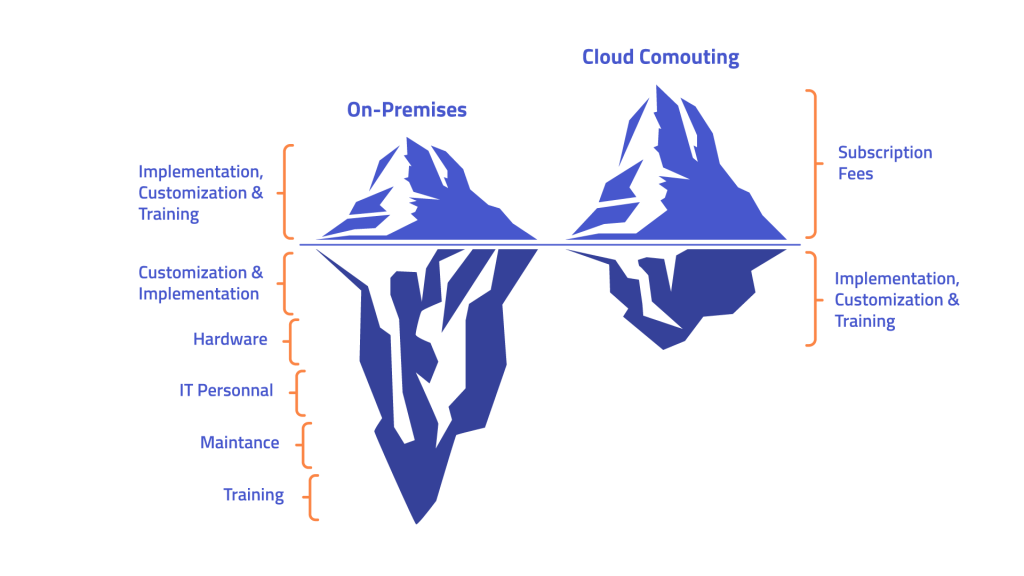
Creating a data center within the company, in addition to the initial shocking costs of purchasing equipment and hardware, imposes huge ongoing expenses on your company to maintain this equipment.
These expenses are so high that, according to numerous studies, migrating to cloud services can reduce your expenses by between $361 and $401.
The Pay as you Go feature allows you to spend only what you use and avoid additional costs.
With cloud services, your initial cost will not be comparable to the costs of establishing a data center within the company.
Some of the expenses that are reduced or eliminated in cloud services include;
Infrastructure and Network
The cost of these types of equipment is often considered a “hidden expense” in building data centers and internal servers because it can cost more than purchasing servers and hardware. Network cards, routers, power supplies, and switches are just some of the infrastructure costs that are eliminated in cloud computing.
Server and hardware
New servers require hardware such as CPU, RAM, etc. and are very expensive. Using old and outdated servers (even if they have the ability to be cloud-based) increases the failure rate of the cloud. One of the advantages of many cloud solutions is that there is no need for expensive initial costs for hardware and servers. In this way, your capital cost becomes an operating cost.
Human resource expenses
Reducing the time it takes to create and establish appropriate infrastructure and eliminating the need for a large number of network specialists to maintain the infrastructure saves you on human resources costs.
Space cost
In our country, the cost of space is very high and creating a “server room” would be very expensive. With cloud computing, there is no need to involve your company or organization in precious space.
Security measures
Internal servers contain sensitive and sensitive information, which requires high security measures. Security costs, backup and support solutions, fire extinguishing systems, etc. are also not used.
Opportunity cost
There is an old adage that goes, “Time is money.” Building the right infrastructure is a time-consuming process that is incomparably reduced in cloud computing.
Software
The licenses you need are provided on a broad level for cloud services, which breaks down their costs and makes them more cost-effective for you.
Overhead cost
These costs may not seem large at first glance, but the continuous maintenance of a large number of hardware, cooling systems, network infrastructure, etc. consumes a lot of energy and will naturally be costly.
Information security
85% Companies They upload their confidential information to the clouds..
Establishing an infrastructure that is security-compatible with public clouds is, at best, very expensive (even if it is feasible).
Cloud companies have dedicated very large security units to enhance their services so that your data is hosted in a secure environment. Some of the advanced security features used in cloud hosting infrastructure include:
- Web-based firewalls (WAFs)
- Anti-DDoS
- Antivirus and security measures
- Disaster Recovery
And…
Some people may believe that “if information is not stored on-site, it is not secure.”
It is interesting to know that More than 90% information leaks occur from employees of organizations. For this reason, hosting information within the company reduces information security.
Statistics also show that 94% Businesses that used cloud services saw increased information security.
Even if company employees don't leak information, a simple infection or hardware failure can wipe out all your data.
Therefore, in addition to increasing security from the cloud platform, data is protected from the ability Data Redundancy and Disaster Recovery benefited from Your information is stored simultaneously in multiple locations around the world. and Stay safe under all circumstances..
Cloud computing
The future of businesses and organizations
Cloud computing has been around for some time now. The savior of online businesses and large organizations Due to the benefits of cloud computing, more and more businesses and organizations are adopting it. Implementation and Immigration They are towards these services.
In International level More than 90% Companies use at least one type of cloud service – And another 90% are also considering migrating to cloud services..
These statistics reveal evidence that Large companies are using cloud services. (Or they will soon go this way)
The number of small businesses (under 100 people) that will use cloud services in the next 6 years 2 will be equal.
These trends Global They are and despite The many benefits of cloud computingHowever, these types of services have not yet been widely used in Iran. Coming soon We will witness widespread use of the benefits of cloud computing and services by Iranian companies, which, by utilizing this solution, Reduced their costs. and They have improved their work productivity.
There is no doubt that due to the many benefits of cloud computing, this type of service will shape the future of web hosting and its use is inevitable for your business, whether you use a cloud server or a complex customized cloud service.